How it works

Four moves. One loop you can check.

Employers set the bar, gaps get diagnosed, capabilities get augmented, readiness gets verified — all circling one shared evidence base. The output is a credential anyone can check.

The GradiumOS loop: Convert demand, Diagnose gaps, Augment capabilities, Verify readiness — circling one shared evidence base.
One evidence base

Three parties. One shared, checkable record.

Three portals, one assessed evidence base. One claim, one meaning.

Institutions Employers Learners One shared evidence base GOS-signedSignal
The loop · exact order

Convert demand · Diagnose gaps · Augment capabilities · Verify readiness.

Four moves on the shared base. The output loops back.

1

Convert demand

A pasted JD becomes cluster-level hiring bars.

2

Diagnose gaps

Cohort scored across eight clusters.

3

Augment capabilities

Guided pathways target the clusters that fell short.

4

Verify readiness

Checklist passes → a GOS-signed Signal. Anyone can check it.
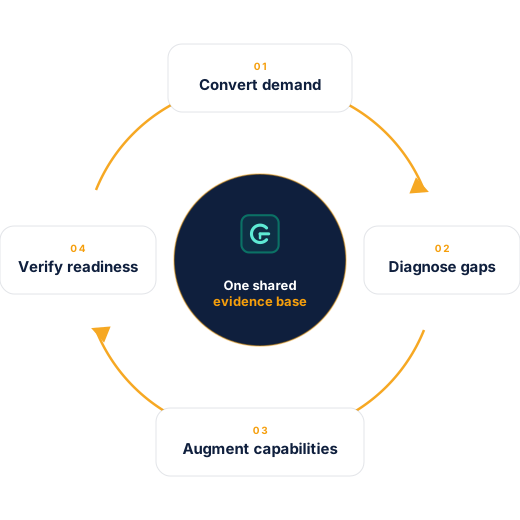
The GradiumOS loop circling one shared evidence base: convert demand, diagnose gaps, augment capabilities, verify readiness.

The output verifies, then loops back to demand.

The shared language

Eight competency clusters.

One language for dean, employer and learner.

C1Core Technical Foundations92
C2Applied Problem Solving99
C3Engineering Execution100
C4System & Product Thinking100
C5Communication & Collaboration100
C6Domain Specialisation82
C7Ownership & Judgment88
C8Learning Agility95
Three portals

One evidence base, seen three ways.

Campus · institutions

Run the cohort

Map demand to readiness. Diagnose gaps, augment capabilities, verify readiness.

Open Campus demo
Workforce · employers

Hire on evidence, never self-rating

JD becomes hiring bars. Discover, verify, pipeline.

Open Workforce demo
Talent · learners

Own a portable credential

Build evidence, close gaps, carry a verifiable Signal.

Open Talent demo
Anatomy of a Signal

Every region is checkable.

GRADIUMOS SIGNAL
Sneha Reddy
B.Tech CSE — AI & Machine Learning
GOS-signed
SRM Institute of Science and Technology
0.70 confidence
91READINESS
C1 · Core90
C6 · Domain95
C7 · Own95
GOS CODE
GOS·SIOSA·BCAML·26·0012·STEKY
GOS-signedissued 29 Jun 2026 · expires 29 Jun 2027
  • HOLDERWho and what. Track and institution — the headline claim.
  • READINESSOne number, eight parts. Derived from clusters, with evidence-confidence beside it.
  • CLUSTERSThe shared language. Per-cluster scores (C1–C8). Strength and gap, not just a pass.
  • GOS CODEThe human handle. GOS·INST·TRACK·YY·SERIAL·CHECK — paste into Verify yourself.
  • SIGNATUREThe proof. GOS-signed (Ed25519). Change one character, the check fails.
Lifecycle

From evidence to expiry.

1

Issued

Only when the evidence checklist passes. No checklist, no Signal.

2

Carried

Held by the learner. They choose when to present.

3

Verified

Anyone checks against published keys. No account, no PII returned.

4

Expires · revocable

Every Signal expires. Holder can revoke. Tamper-evident throughout.

Privacy posture

Consent before identity. Always.

No identity without consent

Discovery on evidence, not names.

Aggregates protect the few

K-anonymity floor of 5. No group singled out.

Verification returns no PII

Only validity and dates. No name, no marks.

DPDP-aligned by design

Minimisation and consent, per India's DPDP Act 2023. Privacy note →

Two ways in

Demo or your own workspace.

 The live demoYour own workspace
AccessOpens instantly · no loginSign-up and login gated
DataSeeded: 5 institutions · 200 learners · 60 SignalsCompletely empty — your data only
WritesServer-enforced read-onlyFull read & write
Best forEvaluating what it doesRunning a real cohort